
Land a Tech Job: a 30–90 Day, Evidence‑First System
Choose your path, build proof, tailor applications at scale, and win interviews with a streamlined, automation‑assisted process — no gimmicks.
What you'll build
A practical, end‑to‑end job search system: pick the right tech track, ship small but strong proof projects, tailor resumes in minutes, and create direct conversations with hiring teams. Optional automations help you source roles, score fit, and personalize documents without losing quality.
- Decide between SOC, GRC, or AI‑adjacent roles with a 30‑day test
- Ship explainable projects and a lean portfolio recruiters can skim fast
- Spin up a Sheets‑based pipeline; auto‑tailor resumes and track fit
- Apply, then message three insiders with high‑signal outreach
- Prep behavioral + technical screens with role‑specific drills
Platforms & tools


Step 1 — 🧭 Choose a target role with a 30‑day test
Stop asking which path is better; ask which fits you. Run a 30‑day split test to compare Security Operations Center (SOC) vs Governance, Risk & Compliance (GRC). Then commit to one for your first role.
- Days 1–15 SOC: read 5 SOC job ads; learn SIEM/log/phishing basics; do a defensive lab or log analysis; write a 1‑page summary.
- Days 16–30 GRC: read 5 GRC job ads; learn risk/control/audit/framework terms; create a sample risk register or control mapping; write a 1‑page summary.
- At day 30: Which work made you more curious? Which can you explain clearly? Which gave stronger resume evidence?
Don’t choose GRC because it seems easier — strong GRC still demands clear writing, stakeholder management, evidence, and technical understanding.
Step 2 — 🔎 Understand the day‑to‑day before you commit
Match your temperament to the work. SOC analysts monitor alerts, review logs, triage incidents, investigate phishing, check endpoint alerts, follow playbooks, and document findings. GRC analysts write policies/standards, maintain risk registers, assess controls, review suppliers, and translate regulatory requirements into practical controls.
If applying in Australia, know common frameworks: Essential Eight, Information Security Manual, ISO 27001, privacy obligations, third‑party risk, and CPS 234 (financial services).
 Essential Eight (ACSC)Maturity model overview↗Information Security Manual (ACSC ISM)Baseline security controls↗
 ISO/IEC 27001 overviewInformation security standard↗
 APRA CPS 234Prudential standard (AU)↗
Build role‑appropriate projects: SOC needs labs and technical investigations; GRC needs risk registers, policies, supplier reviews, and control mappings.
Step 3 — 🧪 Build explainable evidence fast
Ship small, auditable projects you can talk through in detail. For SOC: a basic SIEM or log analysis lab, Windows event log write‑up, phishing email analysis, or a defensive learning path with notes. For GRC: a sample cybersecurity risk register, a concise security policy, a mock supplier security review, or control mapping against a framework.
Hiring managers value on‑the‑job project experience and portfolios as much as education and certs — don’t rely only on certifications.
Step 4 — 🧾 Craft a sharp, role‑first resume
Write for F‑pattern skimming: strong headline, tight bullets with measurable outcomes, left‑aligned keywords. Build for the next role (not just the last). Include role‑specific keywords (e.g., Python, basic SQL, JSON/API reading; Zendesk/Intercom for support). If you’re early‑career, highlight course projects, internships, and meta‑skills (time management, collaboration, resilience).
Use an AI assistant to tighten grammar and clarity while preserving your voice.
Avoid weak bullets (e.g., “interested in GRC”). Show you understand artifacts like risk registers or controls; front‑load your strongest proof in the first ~100 characters.
Step 5 — 🗂️ Publish a simple portfolio repo
Create a GitHub repo with 1–3 projects, short READMEs explaining problem → approach → result, and links to any live demos. Treat your creative work like code: version control, commit messages, and changelogs.
Have your resume and metrics ready — access is often revoked immediately during layoffs. Share portfolio links, not large attachments, to reduce friction.
Step 6 — 📊 Build your job pipeline in Sheets
Centralize roles and documents. Create a Google Sheet with columns: Position Name, Job Type, Company Location, Description, URL, Customized Resume, Date Created, Posted At, Scraped At. Add columns for lead tracking: Lead ID, Search Query, Business/Company Name, Category, Address, Phones, Emails, Contacts, Enrichment Status. You’ll map AI outputs (fit score, strengths/weaknesses, justification) into adjacent columns later.
Step 7 — 🧩 Wireframe your workflow (optional but wise)
Sketch triggers, sources, transformations, AI steps, and outputs before you automate. A quick diagram clarifies handoffs (scraper → parser → AI fit → tailored resume → Sheets).
Building without a wireframe wastes time — even a rough box‑and‑arrow map prevents rework.
Step 8 — 🛠️ Set up your orchestrator
Automate repeatable steps (optional). Choose one platform and create a starter flow with an HTTP or scheduled trigger.
| Platform | What to do in this step |
|---|---|
| n8n | Create a new workflow; add a Webhook or Cron node; save. Generate an n8n API key (Settings → n8n API) if an external agent will control runs. |
| Make.com | Create a new scenario; add a Webhooks or Scheduler module; name and save the scenario. |
If pairing with an IDE agent, enable planning mode so the AI drafts a full plan before execution for safer, cleaner workflows.

make.com — where you'll do this
Step 9 — 🔐 Connect Google Sheets to n8n
In n8n, add Google Sheets credentials: create a new Google Cloud project (“job finder”); enable the Google Sheets API; configure the OAuth consent screen (app name + email); create OAuth client (Web app); add the n8n redirect URI; copy client ID/secret into n8n; publish and sign in. Your Sheets are now accessible to the workflow.
Google’s OAuth warning is expected — click Advanced and accept permissions to proceed.
Step 10 — 🤖 Add AI and vendor credentials
| Platform | What to do in this step |
|---|---|
| n8n | Open the OpenAI node and add your API key (create a secret key on OpenAI). Add Claude via HTTP if needed. Save credentials. |
| Make.com | Add the OpenAI (or ChatGPT) module with your API key. Add a Google Sheets module connection. Save the scenario. |
Keep AI outputs structured for downstream mapping (e.g., JSON). You’ll also add Apify next for scraping.
Use a structured output parser or JSON schema so the AI returns strengths, weaknesses, risk, reward, fit, and justification as distinct fields.
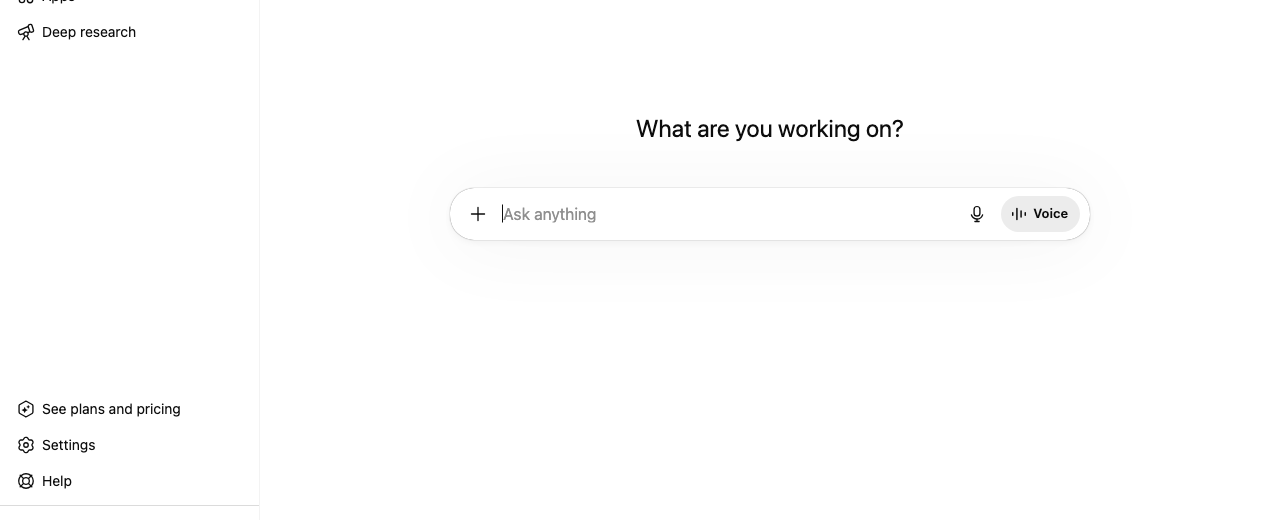
ChatGPT — where you'll do this
Step 11 — 🕷️ Scrape roles with Apify (Indeed actor)
Sign up on Apify, add a payment method, and copy your API key. Understand Apify’s model: Actors (serverless programs), Tasks (configured runs), and Datasets (results). Configure the Indeed Bulk Job Scraper: set job title (e.g., “data engineer”), location (e.g., “San Francisco, United States”), and max items. Trigger via your orchestrator and fetch the dataset for downstream processing.
- Use webhooks or “watch actor runs” to trigger only on new data (save credits, avoid polling).
- Map fields from the dataset into your Sheet (title, company, description, URL, dates).
Avoid auto‑applying on Indeed via scrapers — it risks ToS violations and reputation damage. Use Apify marketplace scrapers instead of building your own to bypass anti‑scraping pitfalls.
Step 12 — 🧼 Normalize resumes and extract contacts
Handle common file types reliably. Branch by MIME type (PDF, DOCX, TXT) and extract standardized text. Add a dedicated information extractor node to parse first name, last name, and email from the resume text (mark all as required).
- Create Switch branches per MIME type; apply format‑specific parsers.
- Standardize to plain text for AI and downstream modules.
Do not overload the AI agent; use a separate extractor node for names/emails to keep prompts simple and outputs predictable.
Step 13 — 🧮 Score job fit with an AI agent
Add an AI agent node with: system message to compare resume vs job description and return strengths, weaknesses, risk, reward, an overall fit rating, and one‑paragraph justification; user message containing clean resume text + job description. Parse the JSON output and map to your Sheet columns.
- Feed prompts with JSON and request JSON back.
- Map to columns: strengths, weaknesses, risk, reward, fit, justification, and resume link.
Treat GPT like an API endpoint: send compact JSON inputs and require strict JSON outputs for reliable downstream handling.
Step 14 — ✍️ Auto‑tailor resumes and store in Docs
Use your orchestrator’s OpenAI/ChatGPT module to tailor bullets and a short summary to the role. Output in markdown ATX headings so you can render cleanly in Google Docs. Save the doc, copy the share link, and add it to your Sheet.
System: You tailor resumes concisely for [ROLE] at [COMPANY]. Keep voice professional, direct, and human. Only adjust bullets that strengthen role alignment.

User: Here is the job post:\n[JOB_DESCRIPTION]\n\nHere is my base resume (markdown headings + bullets):\n[BASE_RESUME_MD]\n\nReturn JSON with keys:\n- summary_intro (2 sentences)\n- top_keywords (<=8, lowercase)\n- tailored_bullets (3–6 bullets, each starts with a strong verb)\n- keep_bullets (list of my unchanged bullets that already match)\n- remove_bullets (list of my bullets to drop)\n- title_line (e.g., "Security Analyst — SOC Tier 1")
Don’t ask the AI to write an entire resume from scratch — keep a solid template and let it update only the parts that prove fit.

Google Docs — where you'll do this
Step 15 — 🧪 Test and harden the automation
Run end‑to‑end with sample roles and a few resume formats. Add resilience: an Ignore/Continue step where non‑critical APIs sometimes fail; a Break/Retry step with exponential backoff for rate limits; Hookdeck to queue, delay (even days), filter, and transform webhooks before they hit your orchestrator. Verify rows append correctly and doc links open.
- Enable storing incomplete executions so you can retry manually.
- Test Hookdeck by POSTing sample payloads; confirm queued/delayed delivery.
Exponential backoff avoids persistent rate limits; linear retries can keep failing. Keep logs and recent executions handy for quick rollback.
Step 16 — 🧠 Research companies and map warm paths
Research the company name, mission, leadership, and product lines. On LinkedIn, filter for people who previously worked where you did and now work at your target company — these are your best warm intros. Identify the likely recruiter/hiring manager, a peer in the role, and a nearby sales leader who can amplify signals internally.
Messaging hiring managers on LinkedIn after applying is overdone and often ignored — a crisp email and a warm intro work better.

LinkedIn — where you'll do this
Step 17 — 📬 Apply, then message three insiders
Apply with your tailored resume and a short cover paragraph. Then reach out to three people: the recruiter/hiring manager, a team member in the role, and a sales leader. Keep it brief, personalized, and focused on value.
Subject: Quick intro for [ROLE]

Hi [Name],

I noticed you may be leading hiring at [Company]. I’m applying for the [ROLE] role and wanted to share my resume directly. I’d love to speak about how my background in [RELEVANT EXPERIENCE/TOOLS] and recent projects (link below) could help the team.

Thanks for the consideration,
[Your Name]
[Portfolio/Repo Link] • [Phone]
Subject: [Personalized hook for [Name]]

Hi [Name],

See that you’ve been on the [TEAM NAME] team at [Company] since [YEAR]. I’m exploring the [ROLE] opening and wondered if you’d share what the culture and day‑to‑day feel like. Any perspective would be appreciated.

Thanks in advance,
[Your Name]
Subject: [Personalized hook for [Name]]

Hey [Name],

I was just speaking to [Referrer Name] about the [ROLE] opening and they mentioned you’re the right person. I’d love to connect to see how my background in [RELEVANT SKILLS] might align.

Do you have time in the coming days to chat?

[Your Name]
I'd be very interested to get your expert opinion on this industry and where it's going — could you spare some time?
Use multiple platforms (email, LinkedIn, Twitter) so at least one message is seen. Personalize with one concrete detail from their profile or product.
Step 18 — 🧾 Upwork: send high‑signal proposals (if freelancing)
Complete every profile section (portfolio, skills, testimonials, certifications, project catalog, linked accounts). For each target job, submit a tight, personalized proposal. Optionally auto‑generate a proposal, a Google Doc version, and a simple Mermaid system diagram from the job description.
System prompt: You are a helpful intelligent Upwork application writer.

User prompt: Your task is to take as input an Upwork job description and return as output a customized proposal.

Template example: Hi, I do [thing] all the time. I'm so confident I'm the right fit for you that I just created a workflow diagram plus a demo of your {{job description}} in no code. [Link]

About me: I'm a [relevant job description] that has done cool relevant things of note, other cool tie-ins. Very neat. Happy to do this for you anytime, just respond to this proposal else I don't get a chat window. Thank you.

Rules and formatting: Output in JSON format with keys for each section, use new line delimited bullet points, avoid emojis and flowery language, use first-person language.You are a helpful intelligent proposal writer. I'm an automation specialist applying to jobs on freelance platforms. Your task is to take as input an Upwork job description and return as output JavaScript object notation for a customized proposal which I'll upload to Google Docs. High performing proposals are typically templated as follows: - Title of system - Brief explanation of system - Hi, as mentioned, I'm so confident I'm the right fit for this that I went ahead and created a proposal for you including a step-by-step of how I do it. - I've done the below many times and working with [specific part of their request] is one of my favorite parts of automation. - Here is how we'll build all of this stuff: left to right flow with arrows. - A little bit about me: bullet points. Rules: - Write in a casual Spartan tone of voice. - Don't use emojis or flowery language. - If there's a name in the job description, add it. - Return step-by-step bullet points. - Delimit each bullet point with a backslash and include a hyphen. - Prefer not to mention social proof that includes money and numbers in about me bullets. - Use first-person language.
Your task is to take as input an Upwork job description and return as output a Mermaid diagram that I can visualize using a subsequent Mermaid live editor.

Example output:
graph TD
A[Receive email from Facebook lead ads] --> B[Add to CRM]
B --> C[Send customized SMS]

Rules:
- Only output flowcharts, no sequence diagrams, no Gantt charts.
- Do not output any accessory formatting information like backticks.
- Your first character should be 'g' (for graph TD).
Most competition on Upwork underperforms. Consistent, personalized proposals plus a small demo link can set you apart fast.
Step 19 — 🎥 Record a 60–120s Loom intro
Create a short Loom: who you are, why this specific role/team, one relevant project, and a clear ask for a chat. Share the Loom link in outreach and applications.
Scroll the target’s LinkedIn or website during recording — a static screen looks like a screenshot and reduces perceived effort.
Step 20 — 🗣️ Build a lightweight LinkedIn presence
Use a vertical list of expertise to create a quick “checkmark effect.” Post short, useful notes 2–3x/week using a “document, don’t create” approach (capture lessons from projects and interviews). If automating posts, store generated text in a Sheet and post hourly to open slots.
- Schedule by sorting existing times and adding +1 hour to the latest.
- Replace \n with your platform’s newline function for clean formatting.
- Randomize minor styling (e.g., asterisks) to avoid repetition.
Front‑load the first ~100 characters with your best proof — that’s what most readers (and recruiters) actually see.
Step 21 — 💼 Nail behavioral fundamentals
Prepare a crisp, 60–90s “Tell me about yourself” aligned to the job description. Use 2–3 STAR stories showing you solved difficult customer problems, stayed calm under pressure, and went above/beyond. If a company asks for an application number you don’t have, politely email recruiting or the generic inbox asking how to locate it.
- Rehearse out loud; trim jargon; tie back to role needs.
- Have 2 stories each for impact, conflict resolution, and learning.
Read the job description thoroughly before interviews — failing to mirror desired skills is a common deal‑breaker. Avoid “volcano answers” that hint at unresolved issues.
Step 22 — 🧠 Prep technical screens by track
SOC: Practice log review, basic SIEM usage, phishing triage, and writing concise incident notes. GRC: Practice drafting a policy paragraph, creating a simple risk register, and mapping a control to ISO 27001 or Essential Eight. AI/data‑adjacent: Build foundations before prompts — EDA, statistics, and classic ML.
- Data prep: handle missing values (drop if <5%, else impute mean/median/mode appropriately; prefer median for skew).
- Scaling: min‑max or z‑score depending on algorithm needs.
- Supervised vs classification/regression; semi‑supervised; reinforcement learning basics.
- Algorithms to know: linear/logistic regression, k‑NN, decision trees, random forest, SVM, XGBoost/CatBoost.
- Evaluation: accuracy for classification; error metrics for regression; cross‑validation, regularization, hyperparameter tuning, ensembles.
- Python stack: pandas, numpy, seaborn, matplotlib for EDA/visuals.
Most people chase prompt tips and trending tools first — invest in fundamentals. You can’t predict categories absent from training labels.
Step 23 — 🛎️ Tailor for support/ops coordinator roles
If targeting customer support or operations coordinator roles, emphasize documentation rigor, ticketing systems, calm communication, and tool fluency. Add relevant keywords (Zendesk, Intercom, HIPAA where applicable; basic APIs/SSO/troubleshooting; JSON). Quantify throughput and accuracy.
- Example metric: process 500+ records/week at 99% accuracy (example-only).
- For Onboard: basic APIs/SSO/browser logs knowledge is a plus (not required).
If you struggle to talk confidently about yourself, you’ll struggle with customers and peers — practice short, direct explanations of your work.
Step 24 — 📆 Confirm logistics: shifts, location, equipment
Check remote eligibility (some companies hire only in specific states). Confirm shift windows before applying. Some roles provide equipment or stipends; note them when evaluating offers. If the schedule is in Pacific Time and you’re elsewhere, translate your local hours accurately.
- Some roles require occasional weekends/holidays.
- Certain postings provide laptops or stipends.
You don’t need to live in Pacific time for some roles — just ensure your local hours align with the posted shift.
Step 25 — 🔄 Follow up and close loops
Send a tight thank‑you note within 24 hours of each interview; highlight one insight from the conversation and restate your value. If you haven’t heard back after the stated timeline, nudge once with new proof (a short write‑up, dashboard, or tiny fix) that shows momentum. For informational chats, ask for a next intro or one clear action.
Subject: Thank you — [ROLE] at [COMPANY]

Hi [Name],

Appreciate our chat on [DAY]. I pulled together a quick [artifact: 1‑page note/mini‑dashboard/repro steps] based on [topic discussed]. It shows how I’d approach [problem] in the role.

If helpful, happy to walk through it live. Thanks again for the consideration.

[Your Name] • [Link]
Interviews are brief snapshots — leave a memorable, useful artifact rather than just re‑asking for status.
Salary Estimate
Blend structured courses with real work. Most learning happens on the job; formal credentials help you speak the language. If you pursue PM/Agile tracks, note prerequisites before investing.
 AI for Everyone (Coursera)Non‑technical AI fluency↗Google Cloud Machine Learning Engineering (Prof. Cert.)ML skills pathway↗
 PMP CertificationPrereqs and details↗PMI‑ACP (Agile) CertificationPrereqs and details↗
 Certified ScrumMaster (CSM)Training + exam info↗
Mistakes to avoid
Blasting generic apps (or scraping to apply) can violate ToS and hurt your reputation. Personalize and target.
Template your document and let AI fill small portions for predictability and control.
Portfolios and small working projects carry weight — don’t rely solely on certs.
Only pinging a hiring manager on LinkedIn is low yield; use email and warm intros too.
Failing to mirror the job description’s priorities leads to generic answers and rejections.
Automating without a simple diagram wastes time. Add retries/ignore where APIs flake.
LinkedIn/job sites block scrapers; use Apify marketplace actors instead of rolling your own.
If you can’t explain your work clearly, you’ll struggle with customers, coworkers, and interviews.
Salary Estimate
Resources
 TryHackMeHands‑on security labs for SOC evidence↗
 Hack The BoxTechnical challenges and labs↗Essential Eight (ACSC)GRC control baseline (AU)↗Information Security Manual (ACSC ISM)GRC control catalog (AU)↗ISO/IEC 27001 overviewInformation security management↗APRA CPS 234AU Prudential standard↗AI for Everyone (Coursera)AI fluency↗Google Cloud Machine Learning Engineering (Prof. Cert.)ML pathway↗PMP CertificationProject management credential↗PMI‑ACP (Agile) CertificationAgile credential↗Certified ScrumMaster (CSM)Scrum credential↗
Table of Contents
This guide is 1% of what members get
All 7 tools, 100+ grounded playbooks and 252 vetted tools, prompts and repos — on one membership.
Land your dream job. Start your dream business.
Swipe real ATS jobs — we fill out and submit each application.
Score your resume 0–100 against live roles before you apply.
Recruiter-tested one-page resume, auto-built from your LinkedIn.
Paste a job link — get tested + your fastest study path.
252 vetted tools, prompts, repos and GPTs across 86 categories.
338,947+ live ATS jobs across 18,000+ company boards.
100+ grounded, step-by-step income playbooks.
Join free today — All-Access is $7 for 7 days, then $27/month. Cancel anytime.
Learn More →